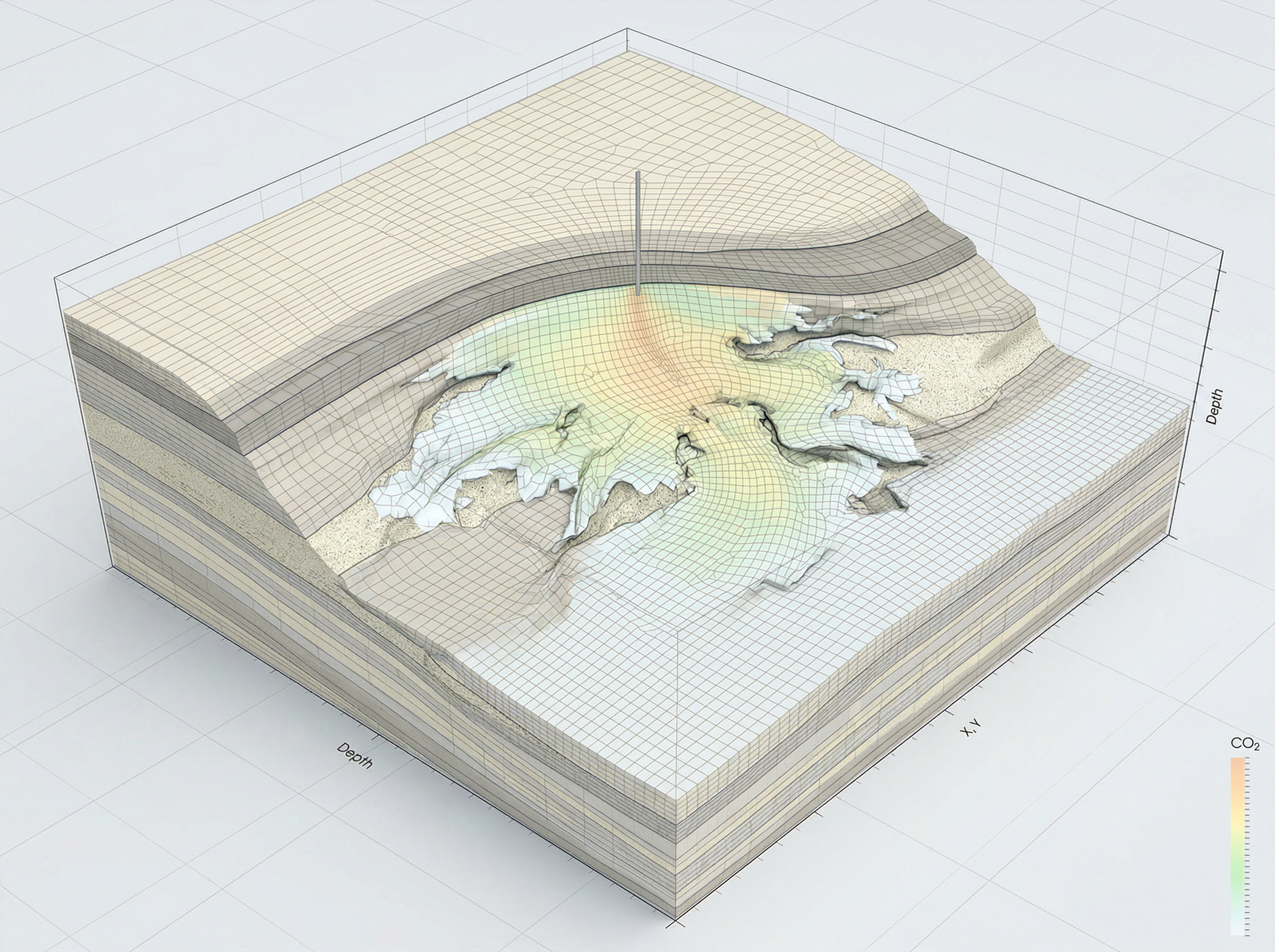
A recent discussion with Tommy Bratton at RMAG underscored something we see regularly in carbon storage projects: the significance of test models, and how simplifying assumptions during the testing phase can drastically alter the outcomes of final models. We ran 100 realizations of a CO2 sequestration model — roughly one million cells, one fault, one well — and the results tell an important story about why shortcuts cost more than they save.
The Problem with Shortcuts
Test models help us formalize our thinking, identify weaknesses or flaws as we work toward a final solution. But the financial pressures of a commercial project often encourage teams to take shortcuts during the testing phase — use software other than what they intend to run for the final case, simplify the geology, reduce the grid resolution, or skip sensitivity runs altogether.
It's not uncommon for clients to be taken aback by how much simplifying assumptions can change the outcomes of their final models. They often walk away feeling that they have spent money or wasted precious time, only to discover that their test models provided little insight into the ultimate solution.
100 Realizations in 8.75 Hours
For this study we built a model domain with approximately one million cells, a single fault, and one injection well. We then ran 100 realizations with GPU-assisted simulation. The total computation time: 8.75 hours. The same study on CPU-only hardware? Too long to be practical.
That difference matters. When you can run 100 realizations overnight, you're not guessing at uncertainty — you're characterizing it. You get a real P10, P50, and P90 for plume extent, and you can show regulators and stakeholders the full range of possible outcomes rather than a single deterministic case.
What the Results Show
The plume area results across the probability distribution tell a clear story:
- P90 (conservative case) — approximately 0.35 square miles of plume extent
- P50 (most likely case) — approximately 0.36 square miles
- P10 (upside case) — approximately 0.70 square miles
The difference between P90 and P10 is a factor of two. That's the kind of range that matters for Class VI permit applications, Area of Review delineation, monitoring well placement, and long-term liability assessments. A single deterministic run would give you one number and no sense of whether it's conservative or optimistic.
Modern Simulators Are Changing the Narrative
This kind of study wasn't practical a few years ago. Running 100 realizations of a million-cell compositional model would have required weeks of compute time or a massive cluster. Modern reservoir simulators driven by contemporary code that scales to modern GPU hardware are redefining what's possible.
The takeaway isn't just about speed — it's about doing the engineering right. When the computational barrier drops, you stop making compromises that weaken your analysis. You run enough cases to actually quantify the uncertainty. You deliver results that hold up under regulatory scrutiny and give operators the confidence to move forward.
Build It Right the First Time
Talk to the team at Ridgeline Engineering and let us help you build it right the first time. Whether you're working through a CCUS feasibility study, preparing a Class VI permit application, or evaluating storage capacity, we bring the simulation tools and subsurface expertise to deliver results you can trust. Get in touch.