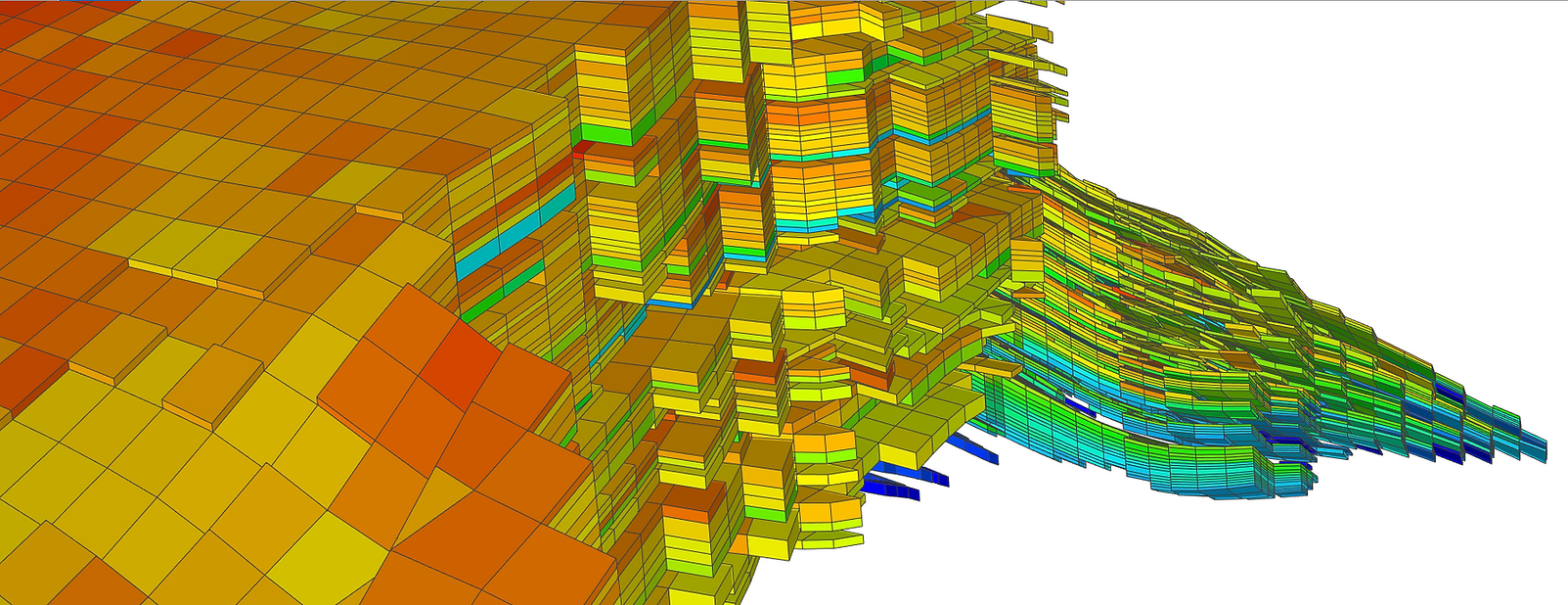
In reservoir simulation, time isn't just money — it's the difference between running one scenario and running hundreds. GPU-accelerated simulators are fundamentally changing what's practical in subsurface modeling, and at Ridgeline Engineering we've been putting that to the test.
The Problem with Traditional Simulation Workflows
Anyone who has spent time building and running reservoir models knows the bottleneck. You set up a complex compositional model, launch the run, and wait. Sometimes for hours. Sometimes overnight. That turnaround time has real consequences: fewer sensitivities get tested, uncertainty quantification gets shortchanged, and engineers end up making upscaling compromises just to get results back in a reasonable timeframe.
When simulator setup and runtime eat half your day, the engineering suffers. You spend more time babysitting software than actually interpreting results and making decisions.
What GPU Acceleration Changes
We've been working with ECHELON from Stone Ridge Technology — a reservoir simulator built from the ground up for GPU hardware. The difference is immediately apparent: clean startup, GPU acceleration, multithreaded well solve, compositional physics, and no drama. A run that used to take hours finishes before your coffee gets cold.
But raw speed is only part of the story. What GPU acceleration really unlocks is better engineering workflows:
- Uncertainty quantification — Run hundreds of realizations in a fraction of the time. Instead of picking three "representative" cases, you can actually characterize the full range of outcomes.
- Sensitivity analysis — Test more parameters, more thoroughly. When each run takes minutes instead of hours, you explore the parameter space properly.
- Higher-resolution models — Stop making painful upscaling compromises. Keep the geologic detail that your geomodeling team worked hard to capture.
- Faster iteration cycles — History match in days, not weeks. Get to the engineering decisions faster.
Fast Software = Better Engineering
The real competitive advantage isn't just speed for speed's sake. It's that faster simulation means more time for actual engineering — interpreting results, testing development scenarios, and delivering better recommendations to clients.
For our work at Ridgeline across conventional and unconventional reservoir simulation and carbon capture and storage projects, this kind of throughput changes what we can offer. More robust uncertainty analysis for reserves estimates. More thorough feasibility studies for CCS projects. Better-informed field development decisions.
Looking Ahead
GPU-accelerated simulation is still early in its adoption curve across the industry, but the direction is clear. As models get more complex — especially in CCUS applications where you're coupling multiphase flow, geomechanics, and geochemistry — the computational demands will only grow. Having simulation tools that scale with that complexity is going to be essential.
We'll continue sharing what we learn as we put ECHELON through its paces on real projects. If you're evaluating simulation tools or want to talk about how faster workflows could impact your development planning, get in touch.